
 EN
EN
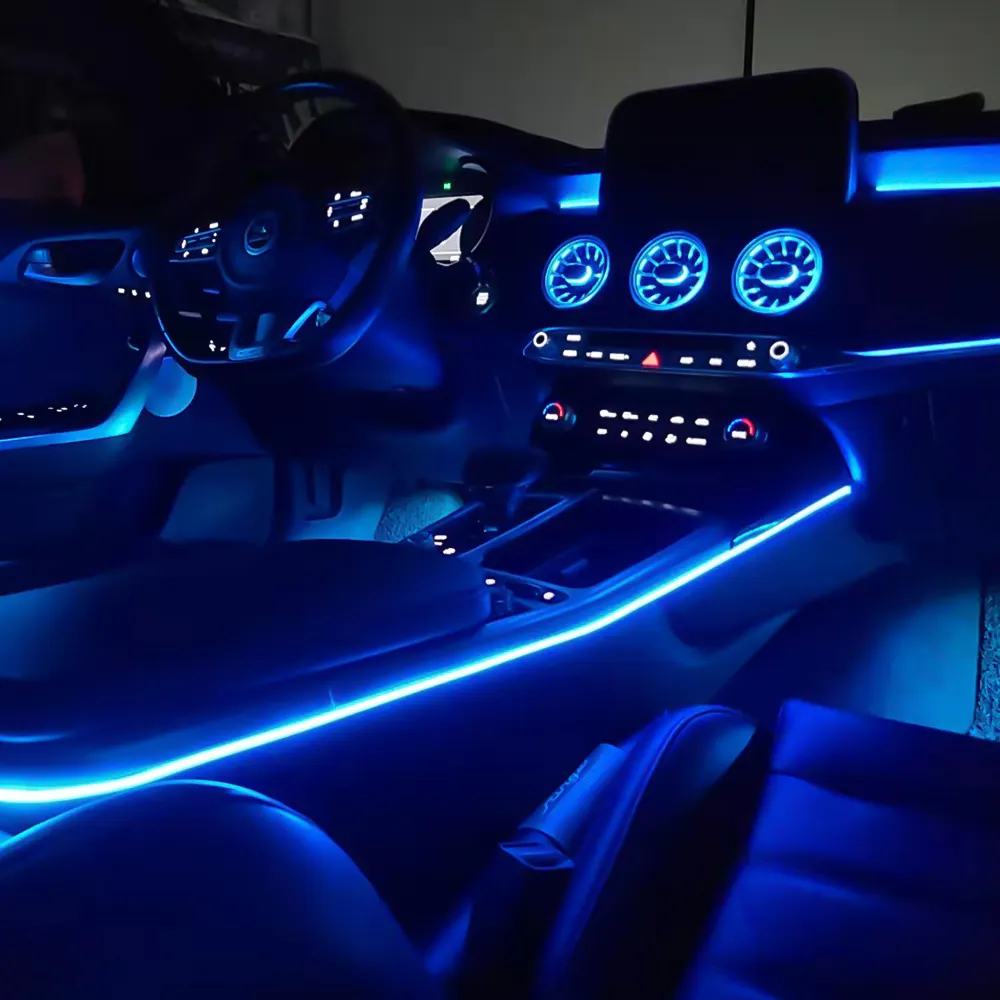
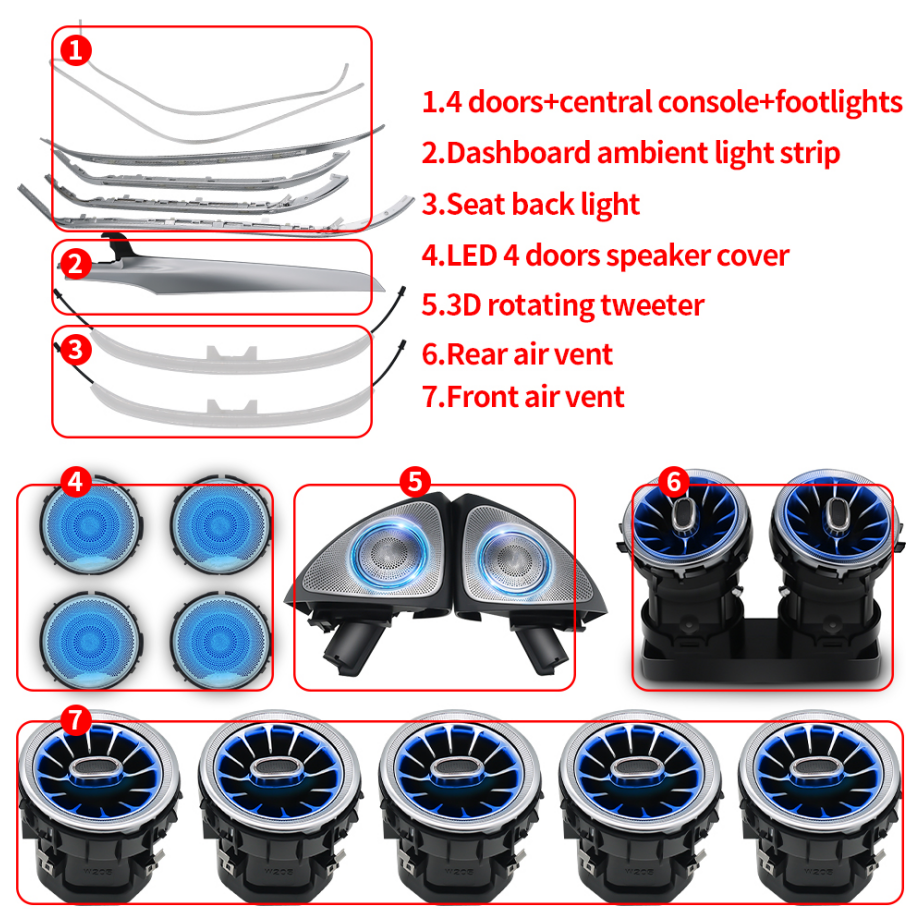
W205 Ambient Light Compatibility: Model Years, Infotainment, and CAN Bus Requirements
NTG5.0 vs. NTG5.5 Systems: How Infotainment Generation Affects OEM Integration
The Mercedes W205 series from 2014 to 2021 needs careful setup when integrating ambient lighting with the infotainment system. Older cars with NTG5.0 systems before 2018 don't support RGB color controls natively. This means installers have to add aftermarket controllers just to get the color signals right. Things changed in 2018 with the NTG5.5 units. These newer models come with built-in support for 64 different colors through their software. The system can sync directly with factory menus now. Still, there's one catch these need CAN bus checks too to keep voltages stable during operation. Looking at Mercedes technical docs shows why this matters so much. About 86% of problems with retrofitted systems happen because of mismatched NTG and CAN signals. Wrong wiring routes cause all sorts of error messages. Before starting any work, it's smart to double check exactly what type of head unit is installed using a VIN decoder tool.
CAN Bus Architecture & Factory Harness Readiness: Identifying Plug-and-Play vs. Retrofit Scenarios
Factory lighting readiness depends on CAN bus wiring configurations. Late-model W205s (2020–2021) often include pre-wired ambient light circuits in door harnesses, allowing plug-and-play activation via coding. Earlier models (2014–2019) typically require CAN emulators to spoof controller signals, with installation complexity varying by zone:
| Scenario | Hardware Requirements | Installation Time |
|---|---|---|
| Plug-and-Play | Harness adapter, coding tool | 1–2 hours |
| Full Retrofit | CAN gateway, RGB controller, wiring | 4–6 hours |
Non-invasive diagnostic checks—including testing pin 14 (CAN High) and pin 6 (CAN Low) for the expected 2.5V baseline—help prevent signal corruption. Industry installers report that skipping this step accounts for 73% of CAN-related failures in DIY setups.
Aftermarket Mercedes Ambient Light Kits: Types, Installation Complexity, and Real-World Fit
Owners of Mercedes-Benz W205 models seeking to enhance cabin ambiance face two primary aftermarket pathways: simplified plug-and-play kits or advanced CAN-based retrofits. Each approach presents distinct trade-offs in installation effort versus feature depth.
Plug-and-Play Kits: Fast Installation but Limited Control and Color Depth
These kits prioritize convenience, typically requiring:
- Direct harness connections without CAN bus integration
- Manual color selection via physical switches
- Basic 3-color RGB lighting (lacking spectral accuracy)
While installations often complete in 1–2 hours, limitations include:
- No synchronization with COMAND or MBUX interfaces
- Restricted brightness and zone adjustments
- Lower CRI (Color Rendering Index), typically under 70, resulting in less accurate hue reproduction
Full CAN-Based Retrofits: Emulation Modules, OBD2 Gateways, and Wiring Best Practices
For factory-like functionality, CAN-based solutions demand greater technical investment:
- Emulation modules mimic OEM lighting protocols to enable menu-level control
- OBD2 gateways intercept and route vehicle communication networks
- Custom wiring harnesses with dedicated CAN-H/CAN-L line integration
Some really important things to think about during installation involve connecting to the CAN gateway located behind the instrument cluster instead of going through the OBD port, which helps prevent issues with safety related modules. Also make sure to find good grounding spots on the vehicle to stop any voltage problems from happening. Don't forget about keeping access to the diagnostic port open so coding can be done properly with tools like XENTRY or DTS Monaco. Get all these right and the retrofit work will actually function as intended without causing headaches down the road.
- Native control via steering wheel buttons and infotainment menus
- A full 64-color RGBW palette with CRI >90
- Dynamic features like music synchronization and ignition-linked scene transitions
Factory-Like Control: Integrating Mercedes Ambient Light into COMAND/MBUX Menus
CAN Message Spoofing for Seamless Menu Integration and Steering Wheel Button Support
Achieving factory-level integration for aftermarket Mercedes ambient light systems requires sophisticated CAN bus manipulation. Specialized emulation modules intercept and replicate OEM lighting control signals, enabling seamless control through the COMAND or MBUX interface. This process involves:
- Decoding proprietary CAN message structures to mirror factory lighting commands
- Mapping inputs to existing steering wheel button functions
- Maintaining sub-50ms latency between user action and lighting response
Successful implementation allows drivers to adjust colors, brightness, and zones directly through native menus—eliminating third-party apps or physical remotes. The system dynamically syncs with door sensors and ignition states, preserving the OEM user experience while enabling full RGBW spectrum customization.
| Integration Factor | Plug-and-Play Kits | CAN Spoofing Solution |
|---|---|---|
| Menu Control | ✖ Not supported | ✓ Native integration |
| Steering Wheel Integration | Limited buttons | Full factory support |
| System Latency | 200–500ms | <50ms |
Professional installers use OBD diagnostic tools to validate message authenticity and signal integrity before finalizing the retrofit—ensuring compatibility with future software updates and preventing conflicts with ADAS or telematics modules.
Advanced Features of Modern Mercedes Ambient Light Systems
64-Color RGBW vs. 3-Color: CRI, Spectral Accuracy, and Interior Ambience Quality
High end ambient lighting setups are starting to come with 64 different colors using RGBW technology, which is way better than those basic three color options most people know about. What really makes these systems stand out is something called the Color Rendering Index or CRI for short. These advanced lights hit CRI scores over 90, pretty much matching how colors look under actual sunlight. Regular three color systems usually fall somewhere below 70 on this scale though. Because of this improved spectrum control, we get much more accurate colors when lighting up spaces. No more strange color bands showing up on walls or ceilings either. Plus, they can produce that clean 6500K white light that just isn't possible with normal RGB combinations. Spaces lit this way feel almost like photographs come to life, adjusting smoothly based on what drivers want and the surrounding environment without any weird color casts ruining the effect.
Zone Control, Music Sync, and Scheduling: Performance, Latency, and App Reliability
Today's systems give us much finer control thanks to multi zone setups that let each area light up separately doors, dashboard, footwells everything gets its own spotlight. When we sync these lights with music though, timing matters a lot. The fancy ones with CAN integration can respond within just 50 milliseconds making sure the lights hit those beats right on time. But cheaper options tend to lag behind sometimes taking over 200 ms which means noticeable delays between the music and the lighting effects. Setting up schedules through phone apps brings in another layer of reliability issues. Systems that work well usually hook into the vehicle's CAN bus instead of relying solely on Bluetooth connections. Real world tests show something interesting too CAN connected systems execute commands successfully about 99.9% of the time compared to around 85-92% success rate for purely wireless setups over a month long period.
Table of Contents
- W205 Ambient Light Compatibility: Model Years, Infotainment, and CAN Bus Requirements
- Aftermarket Mercedes Ambient Light Kits: Types, Installation Complexity, and Real-World Fit
- Factory-Like Control: Integrating Mercedes Ambient Light into COMAND/MBUX Menus
- Advanced Features of Modern Mercedes Ambient Light Systems